PDA Society logo
Cart Icon0
You can purchase access to this training individually. However, you may find even greater value in our subscription package, which includes this session along with exclusive access to all of our other training content. To learn more, please visit our Subscription page →

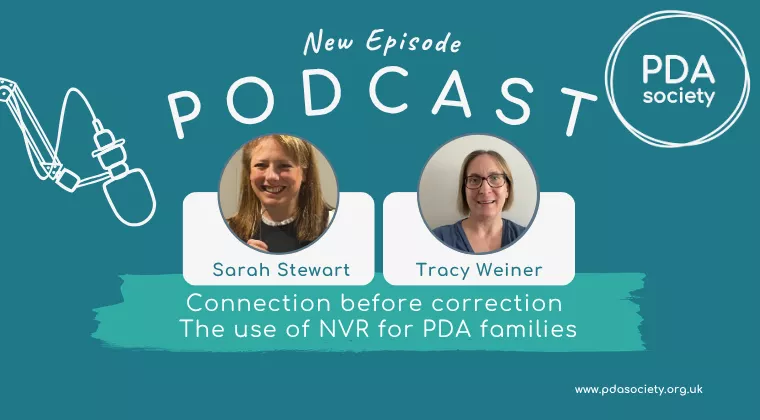
Connection before correction – The use of NVR for PDA families. (Two-Part Podcast)

Available to purchase individually, or access this content as part of our monthly or annual subscription plans.    

See Overview

£10.00

Overview

This two-part podcast is included in our monthly and annual subscriptions, or can be purchased individually.

Explore our subscription options.

In part 1, Sarah Stewart from the PDA Society is joined by Tracy Weiner, an NVR (Non-Violent Resistance) practitioner and parent of a PDA young person, to explore how NVR can support families experiencing high levels of distress and conflict.

Tracy shares both her professional expertise and personal experience as a parent, speaking about the realities of parenting a PDA child into adolescence and adulthood. The conversation focuses on how NVR can offer an alternative approach when families are facing situations such as parental violence and aggression (PVA), where traditional strategies may no longer feel effective.

Part 1 introduces the core principles of NVR, including moving away from control and consequences, and instead focusing on connection, presence, and de-escalation. Tracy explains how NVR shifts the focus from trying to “fix” behaviour to strengthening relationships and reducing conflict over time.

Sarah and Tracy also explore the emotional impact on parents, including fear, isolation, and uncertainty, and how NVR can help rebuild confidence and stability within the family system. The discussion highlights that this approach is not about giving in, but about responding differently to create safer, more sustainable dynamics.


Key Themes

• What NVR (Non-Violent Resistance) is and how it works
• Moving away from control and consequence-based approaches
• Strengthening connection and reducing conflict
• The emotional impact of high-stress family situations
• Rebuilding parental confidence and stability


In part 2, Sarah  continues the conversation with Tracy, focusing on the practical application of NVR within family life.

Building on the foundations explored in Part 1, Tracy responds to questions and shares more detailed insight into how NVR works in real-world situations. The discussion explores how parents can begin to implement NVR principles when things feel escalated, including stepping back from immediate reactions, reducing confrontation, and focusing on presence rather than control.

Tracy talks through how NVR supports parents to hold boundaries in a calm and non-escalatory way, even in situations involving parental violence and aggression. She explains that the approach is not about removing boundaries, but about changing how they are communicated and maintained, with a focus on safety, connection, and consistency.

The episode also explores the emotional journey for parents, including the challenge of letting go of traditional expectations around behaviour and control. Tracy highlights the importance of support networks, shared understanding, and taking small, manageable steps when introducing change.

Part 2 offers practical reassurance and guidance, helping families move from feeling stuck or overwhelmed towards approaches that prioritise safety, dignity, and long-term relationship repair.


Key Themes

• Applying NVR in everyday family situations
• Responding to escalation without increasing conflict
• Holding boundaries in a calm and non-confrontational way
• Supporting parents to step back from reactive responses
• Letting go of control-based expectations
• Building confidence through small, sustainable changes
• The importance of support networks for parents


Disclaimer

The views and opinions expressed by guest speakers in this podcast are their own and do not necessarily reflect those of the PDA Society. While we aim to provide balanced and inclusive discussions, individual experiences and perspectives may vary.

The PDA Society is committed to using language and terminology that reflects the preferences of PDA and autistic people. However, guests may sometimes use language and terminology which differs.

Appearance on our podcast is not an endorsement of an individual, and not all of our guests will align with our position on the issues discussed.


Further sources of support and information

• PDA Society Website: https://www.pdasociety.org.uk/
• PDA Society Training: https://www.pdasociety.org.uk/support-and-training/training/
• PDA Society Support Service: https://www.pdasociety.org.uk/support-and-training/support/


Guest links

• NVR – Haim Omer explains non-violent resistance (40 min)
https://www.nvruk.co.uk/

• Love Languages Quiz – Discover Your Love Language® (Official Quiz)
https://5lovelanguages.com/quizzes/love-language


If you want these two episodes to feel like a matched set on your product page, I can also standardise headings (e.g. “Part 1 / Part 2”) or tighten the tone for consistency.


No reviews yet.


You must be logged in to leave a review.

This content was developed by the PDA Society together with PDAers, family members, and professionals, drawing on a wide range of lived and professional experiences.