
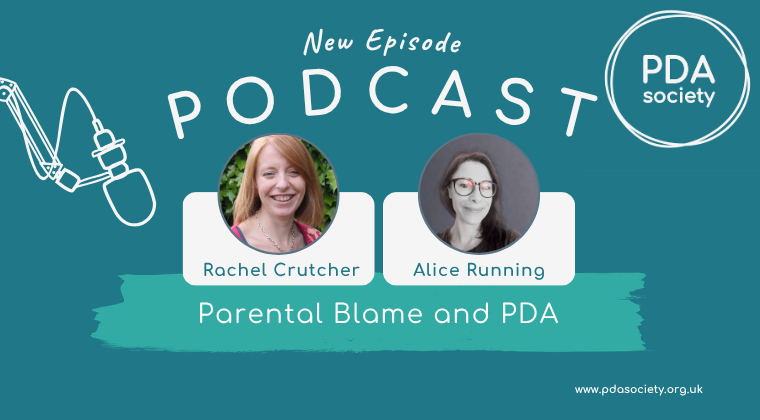
Parental Blame and PDA (Two-Part Podcast)
Available to purchase individually, or access this content as part of our monthly or annual subscription plans.
Overview
This two-part podcast is included in our monthly and annual subscriptions, or can be purchased individually.
Explore our subscription options.
PART 1
In this episode, Rachel from the PDA Society is joined by Alice Running, an author and writer focusing on autistic lived experience and neurodivergent parenting, to explore the issue of parental blame in the context of PDA.
Alice shares both personal and research-informed insight into how parental blame can arise when children struggle within systems that do not fully understand PDA. The conversation explores how behaviours linked to anxiety, demand sensitivity and distress are often misinterpreted, leading to assumptions about parenting rather than recognition of underlying needs.
Rachel and Alice discuss the emotional impact this can have on families, including feelings of shame, isolation and self-doubt. Alice reflects on how blame can become embedded within systems such as education and services, particularly when professionals focus on behaviour rather than context.
Part 1 focuses on understanding what parental blame is, why it occurs, and how it can affect both parents and children. The discussion highlights the importance of shifting towards a more compassionate, informed approach that recognises the child’s experience and the parent’s efforts to support them.
KEY THEMES – PART 1
• What parental blame is and how it shows up for PDA families
• Misinterpretation of behaviour linked to anxiety and demand sensitivity
• The emotional impact of blame on parents and families
• How systems can reinforce blame through misunderstanding
• The importance of context, compassion and neuro-affirming approaches
• Challenging assumptions about parenting
PART 2
In this Deep Diver episode, Rachel continues the conversation with Alice Running, responding to questions from subscribers and exploring how parental blame can be challenged in practice.
Alice reflects on how parents and professionals can begin to recognise when blame is influencing thinking and decision-making. The discussion explores how shifting perspective from “what are the parents doing wrong?” to “what is happening for this child and family?” can open up more supportive and effective responses.
The episode also considers how schools and services can move away from blame-based approaches by developing a deeper understanding of PDA, anxiety and nervous system responses. Alice highlights the importance of listening to parents as experts in their child, and creating space for collaborative, respectful conversations.
Part 2 offers practical insight into how systems and individuals can move towards more compassionate, informed approaches, reducing harm and improving outcomes for families.
KEY THEMES – PART 2
• Recognising and challenging parental blame in practice
• Shifting from judgement to curiosity and understanding
• Supporting collaborative relationships between families and professionals
• The role of schools and services in reducing blame
• Listening to parents as experts in their child
• Moving towards compassionate, neuro-affirming approaches
DISCLAIMER
The views and opinions expressed by guest speakers in this podcast are their own and do not necessarily reflect those of the PDA Society. While we aim to provide balanced and inclusive discussions, individual experiences and perspectives may vary. The PDA Society is committed to using language and terminology that reflects the preferences of PDA and autistic people, but sometimes our guests may use language and terminology which differs. Appearance on our podcast is not an endorsement of an individual, and not all of our guests will align with our position on the issues discussed.
GUEST LINKS
• About Alice Running | AliceRunning
• Parental Blame | AliceRunning
• We Need to Talk About Autism and Parent-Carer Blame by Alice Running | Waterstones