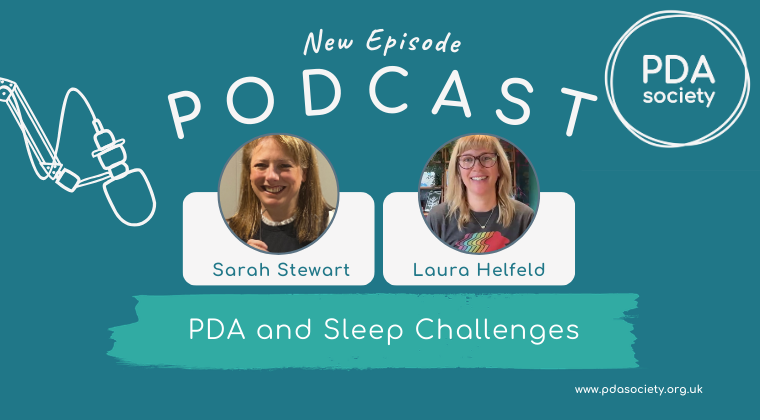
PDA and Sleep Challenges (Two-Part Podcast)
Available to purchase individually, or access this content as part of our monthly or annual subscription plans.
Overview
This two-part podcast is included in our monthly and annual subscriptions, or can be purchased individually. It offers extended discussion, deep insight and practical ideas for understanding nervous systems and how they relate to the experiences of PDAers.
Explore our subscription options.
In Part 1, Sarah Stewart from the PDA Society is joined by Laura Hellfeld, an independent nurse, sleep consultant and PDA adult, to explore why sleep difficulties are so common for PDA children and adults, and what can help.
Laura brings both professional and lived experience to the conversation. She works extensively with families around daily living skills, including sleep, eating, hygiene and transitions, and she is also a parent to PDA children herself. Together, Sarah and Laura discuss how sleep challenges are often one of the most persistent and exhausting difficulties faced by PDA families.
The conversation looks at why sleep can feel so hard, including the role of anxiety, nervous system regulation, demand sensitivity and sensory differences. Laura explains how traditional sleep advice often does not work for PDAers, and why approaches that rely on control, routine or external pressure can increase distress rather than improve rest.
Part 1 focuses on understanding the underlying reasons behind sleep difficulties in PDA, and reframing sleep not as a behaviour problem, but as a nervous system issue that requires safety, flexibility and compassion.
In Part 2, Sarah continues the conversation with Laura Hellfeld, focusing on practical, compassionate approaches to supporting sleep for PDA children and families.
Building on the understanding explored in Part 1, Laura shares deeper insight into what can help when sleep feels persistently difficult. She discusses how demand sensitivity, anxiety and nervous system dysregulation can show up at bedtime and overnight, and why flexibility and responsiveness are often far more effective than rigid routines or sleep training approaches.
The conversation explores realistic strategies for reducing pressure around sleep, supporting regulation before and during the night, and helping families move away from battles, expectations and self-blame. Laura also reflects on the importance of meeting families where they are, acknowledging exhaustion, and recognising that “good enough” sleep support can look very different from conventional advice.
Part 2 offers reassurance, validation and practical guidance for parents who feel stuck, worn down, or unsure how to support sleep in a way that feels kind, safe and sustainable.
Further sources of support and information
- PDA Society Training Hub: https://training.pdasociety.org.uk/pda-podcasts/
- PDA Society Website: https://www.pdasociety.org.uk/
- PDA Society Training: https://www.pdasociety.org.uk/support-and-training/training/
- PDA Society Support Service: https://www.pdasociety.org.uk/support-and-training/support/
Disclaimer
The views and opinions expressed by guest speakers in this podcast are their own and do not necessarily reflect those of the PDA Society. While we aim to provide balanced and inclusive discussions, individual experiences and perspectives may vary. The PDA Society is committed to using language and terminology that reflects the preferences of PDAers and autistic people, but sometimes our guests may use language and terminology which differs. Appearance on our podcast is not an endorsement of an individual, and not all of our guests will align with our position on the issues discussed.