
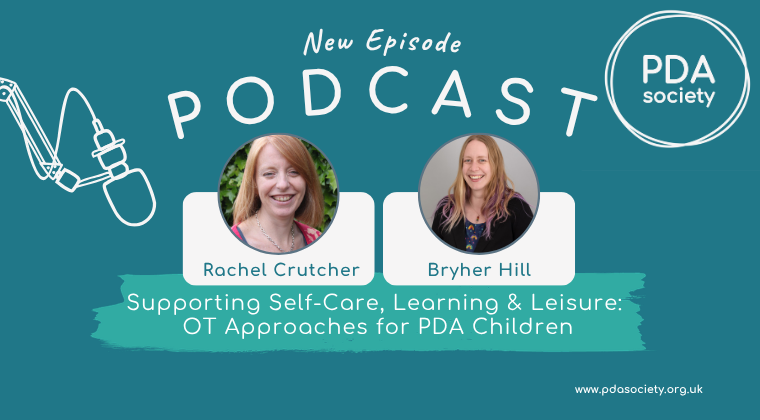
Supporting Self-Care, Learning and leisure: OT Approaches for PDA Children (Two-Part Podcast)
Available to purchase individually, or access this content as part of our monthly or annual subscription plans.
Overview
Supporting Self-Care, Learning and leisure: OT Approaches for PDA Children
This two-part podcast is included in our monthly and annual subscriptions, or can be purchased individually.
Explore our subscription options.
In this episode, Rachel from the PDA Society is joined by Bryher Hill, an occupational therapist from Helping Kids Shine, to explore how occupational therapy can support PDA children and their families.
Bryher shares insight into how occupational therapy looks different when working with PDA profiles, focusing less on compliance and more on understanding the underlying needs driving behaviour. The conversation explores how everyday activities such as self-care, routines and transitions can become overwhelming when anxiety and demand sensitivity are high.
Part 1 – Understanding Occupational Therapy and PDA
Part 1 focuses on understanding the role of occupational therapy in supporting regulation, autonomy and participation in daily life. Bryher explains how observing a child’s sensory profile, nervous system responses and communication style can help identify what is making tasks feel difficult.
The discussion also highlights the importance of adapting expectations, reducing pressure and working collaboratively with the child, rather than imposing routines that may increase distress. Bryher emphasises that small, thoughtful adjustments can make everyday activities feel more achievable and less threatening.
Key Themes
• The role of occupational therapy in supporting PDA children
• Understanding behaviour through a sensory and nervous system lens
• Reducing demands around routines and expectations
• Supporting autonomy and participation in daily life
• Working collaboratively rather than directing
Part 2 – Practical Strategies for Everyday Challenges
In part 2, Rachel continues the conversation with Bryher Hill, occupational therapist from Helping Kids Shine, focusing on practical strategies for supporting everyday challenges.
Responding to questions from subscribers, Bryher explores common areas of difficulty such as self-care, including brushing teeth, getting dressed and bathing. She explains how these tasks can feel overwhelming due to sensory sensitivities, anxiety and perceived loss of control.
The discussion offers practical, flexible approaches to reducing demand, including breaking tasks down, offering choice, adapting environments and prioritising regulation over completion. Bryher highlights the importance of meeting children where they are, rather than pushing through routines that may escalate distress.
The episode also reinforces the idea that progress is not linear, and that supporting a child’s sense of safety and autonomy is more important than achieving consistency in routines.
Key Themes
• Supporting self-care tasks such as dressing, bathing and toothbrushing
• Reducing demand and adapting expectations around routines
• Addressing sensory sensitivities in everyday activities
• Using choice and flexibility to support engagement
• Prioritising regulation over task completion
• Supporting families to take a compassionate, responsive approach
Disclaimer
The views and opinions expressed by guest speakers in this podcast are their own and do not necessarily reflect those of the PDA Society. While we aim to provide balanced and inclusive discussions, individual experiences and perspectives may vary.
The PDA Society is committed to using language and terminology that reflects the preferences of PDA and autistic people, but sometimes our guests may use language and terminology which differs. Appearance on our podcast is not an endorsement of an individual, and not all of our guests will align with our position on the issues discussed.
Guest Links – Helping Kids Shine
Helping Kids Shine empower children, young people and families through Occupational Therapy and Speech and Language Therapy, supporting families to navigate challenges with improved understanding and confidence. With a focus on strengths and neurodiversity-affirming practice, they aim to open doors to brighter futures where children can move from surviving to thriving.
Website: www.helpingkidsshine.co.uk
Facebook: https://www.facebook.com/helpingkidsshineUK/
Instagram: https://www.instagram.com/helpingkidsshineuk/