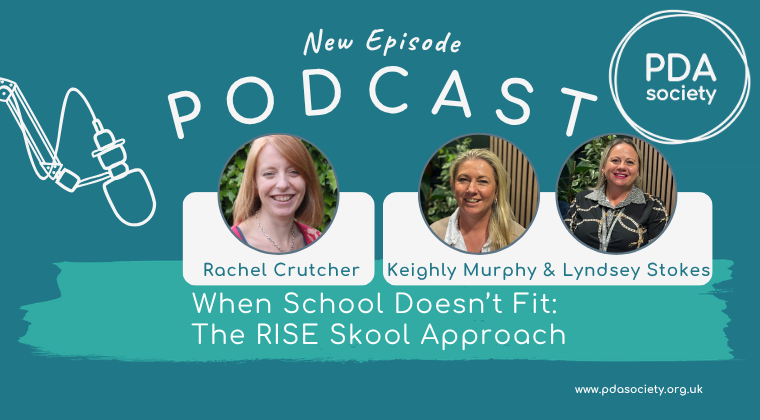
When School Doesn’t Fit: The RISE Skool Approach (Two-Part Podcast)
Available to purchase individually, or access this content as part of our monthly or annual subscription plans.
Overview
When School Doesn’t Fit: The RISE Skool Approach (Two-Part Podcast)
This two-part podcast is included in our monthly and annual subscriptions, or can be purchased individually.
Explore our subscription options.
This two-part podcast explores how alternative education settings like Rise Skool support PDA and neurodivergent learners by prioritising emotional safety, trust and relationships over traditional academic demands.
In this part 1, Rachel from the PDA Society is joined by Lyndsey Stokes and Keighly Murphy from Rise Skool, an alternative education provision supporting neurodivergent children and young people who have struggled in mainstream settings.
Together, they explore what can happen when education is rebuilt around safety, trust and emotional regulation rather than compliance and rigid expectations. Lyndsey and Keighly share how many of the young people who come to Rise Skool have experienced repeated school trauma, exclusions, anxiety or long-term disengagement.
The conversation focuses on creating environments where children feel safe enough to learn. Rather than prioritising academic targets from the outset, Rise Skool centres relationship-building, predictability and co-regulation. Lyndsey and Keighly explain how reducing demands, observing communication patterns and tuning into nervous system responses helps students begin to re-engage.
Part 1 explores how traditional education models can inadvertently escalate anxiety for PDA learners, and how alternative settings can shift from control to collaboration. The discussion highlights the importance of dignity, flexibility and truly listening to young people.
Key Themes
• Why PDA learners often struggle in mainstream education
• The impact of school trauma and repeated exclusions
• Building safety before focusing on academic outcomes
• Relationship-led and co-regulation-based approaches
• Reducing demands to support re-engagement
• Reframing success in education
In part 2, Rachel continues the conversation with Lyndsey Stokes and Keighly Murphy from Rise Skool, responding to subscriber questions about the practical realities of supporting PDA learners in an alternative provision.
Lyndsey and Keighly discuss what those first steps look like when a new student joins Rise Skool. They explain how initial engagement prioritises emotional safety, gradual relationship-building and reducing expectations while trust develops. The focus is not on immediate academic performance, but on helping young people feel secure enough to begin participating.
The discussion moves into balancing flexibility with structure, adapting to fluctuating capacity, and responding to escalation without increasing anxiety. They also reflect on working closely with families who may be carrying the emotional weight of previous educational breakdowns.
Part 2 offers a detailed look at how Rise Skool operationalises its values in everyday practice, creating responsive environments that honour autonomy while maintaining consistent support.
Key Themes
• First steps when a new student joins an alternative setting
• Creating emotional safety through low-demand engagement
• Balancing flexibility with appropriate boundaries
• Responding to escalation without increasing anxiety
• Supporting families alongside young people
• Sustaining trust over time
Disclaimer
The views and opinions expressed by guest speakers in this podcast are their own and do not necessarily reflect those of the PDA Society. While we aim to provide balanced and inclusive discussions, individual experiences and perspectives may vary.
The PDA Society is committed to using language and terminology that reflects the preferences of PDA and autistic people, but sometimes our guests may use language and terminology which differs. Appearance on our podcast is not an endorsement of an individual, and not all of our guests will align with our position on the issues discussed.
Further sources of support and information
• PDA Society Training Hub: https://training.pdasociety.org.uk/pda-podcasts/
• PDA Society Website: https://www.pdasociety.org.uk/
• PDA Society Training: https://www.pdasociety.org.uk/support-and-training/training/
• PDA Society Support Service: https://www.pdasociety.org.uk/support-and-training/support/